Now in beta·iPhone

A clinical reference, redesigned for clarity.

A cited library, the complete suite of nursing calculators, and an AI co-pilot that cites or refusesfor studying, NCLEX prep, and self-directed learning.

iPhone · iPadFree with optional ProFor study and reference. Not a clinical decision tool.
1,200+
drug entries
48
calculators
60
NCLEX-aligned scenarios
100%
cited
Drug · Cardiovascular01 / 03

Metoprolol succinate

Adult · oral · beta-1 selective antagonist

Common dose
25 – 100 mg PO daily
Half-life
3 – 7 h
Renal adjust
not required
Onset
1 – 2 h

Black box. Do not abruptly discontinue — exacerbation of angina, MI, and ventricular arrhythmia have been reported.

DailyMed · openFDA Structured Product Labeling
Calculator · Hemodynamics02 / 03

Mean arterial pressure

Systolic118mmHg
Diastolic74mmHg
MAP89mmHg

Within target perfusion range. Threshold for sepsis-related concern ≥ 65 mmHg.

Surviving Sepsis Campaign · 2021
Co-pilot · Grounded03 / 03

Why does my patient on furosemide need potassium monitoring?

Furosemide is a loop diuretic. It inhibits the Na⁺/K⁺/2Cl⁻ transporter in the thick ascending loop of Henle, increasing renal potassium loss. Hypokalemia (< 3.5 mEq/L) is a known and dose- dependent adverse effect, with risk of arrhythmia in patients also on digoxin.

DailyMed · LiverTox · Open RN Pharmacology, ch. 18

What's inside

The reference, the calculator,
and the co-pilot — in one place.

Search once. Citations carry through. The bundle is the point — three tools that share a library, share a design, and share a posture toward what they will and will not do.

01Library

A reference, fully cited.

Drugs, labs, procedures, diagnoses, communication scripts, and clinical scenarios — every claim sourced to a primary citation, written for clarity and self-directed learning.

Drug entries
1,200 +
Lab interpretations
180
NGN-aligned scenarios
60

openFDA · DailyMed · Open RN · OpenStax · CDC

02Calculators

The complete suite.

Hemodynamics, renal, respiratory, electrolytes, acid-base, anticoagulation. Show your work — every calculator returns a result, a formula, and an interpretive band.

Calculators
48
Always free
all but six
Citations per result
1+

Surviving Sepsis · KDIGO · ATS · ACC/AHA

03Co-pilot

An AI that cites or refuses.

Grounded in the library, scoped to learning. It explains pathophysiology, walks through clinical reasoning, and surfaces guidelines. It does not diagnose. It does not prescribe. It is not for use during patient care.

Average response
< 4 s
Citations per answer
always
Refusal patterns
trained-in

Claude Sonnet 4.7 · grounded retrieval

Inside the app

What it actually looks like.

Real screens, no mockups. Same typeface, same hairlines, same citation discipline as the rest of the product.

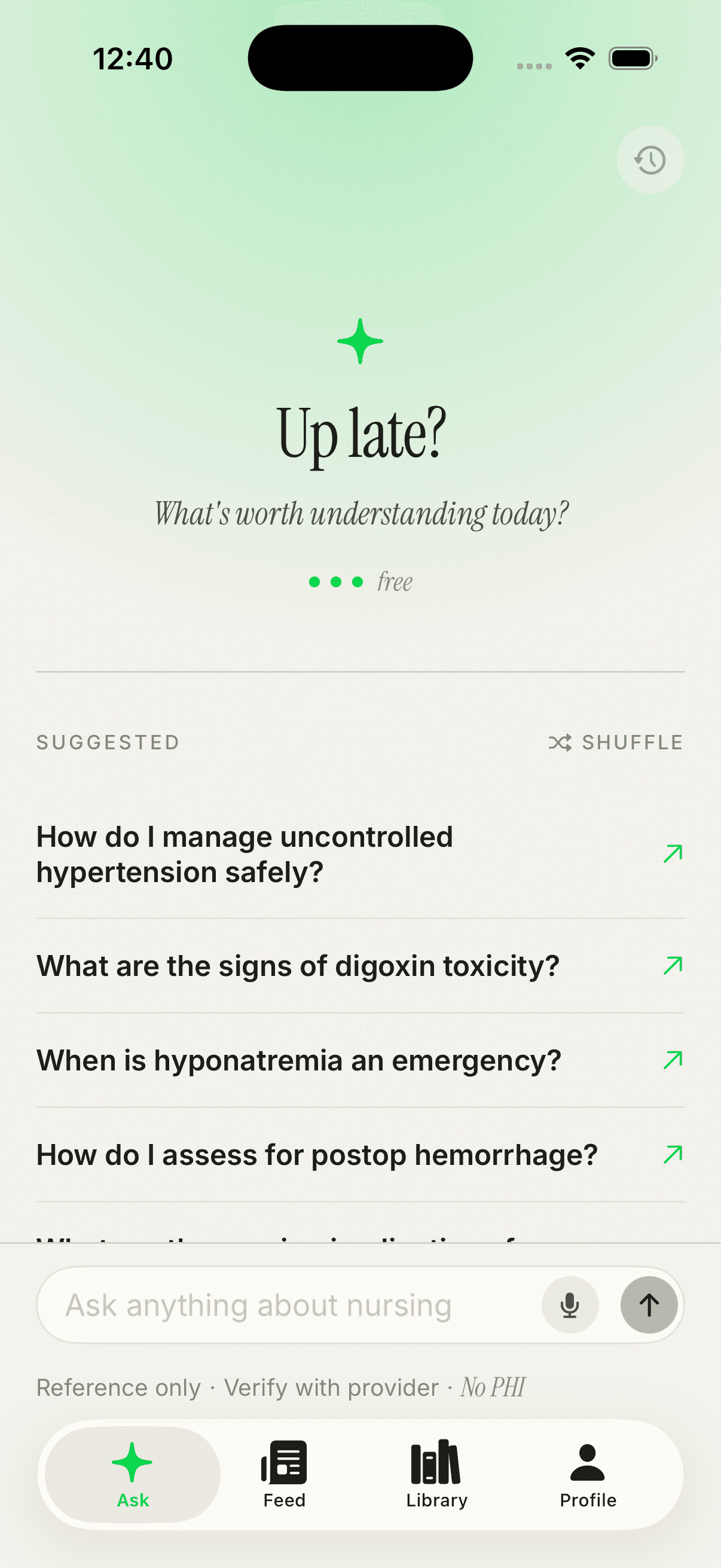
Nursemind Ask home screen — italic display headline 'Ask anything' with quota, NCLEX alignment, and suggested questions
01 / 04Ask · Entry

Ask, scoped to nursing.

The co-pilot opens to a single editorial input. It tells you what it knows — your specialty, the 2026 NCLEX-RN test plan — and how many questions you have left today before you ever type one.

5 of 5 questions left today · Specialty-aware · NCLEX-aligned

Nursemind Library tab — Med-Surg specialty showing browse categories Drugs, Drips, Labs, Procedures, Diagnoses with entry counts
02 / 04Library · Reference

A library that knows your specialty.

Drugs, drips, labs, procedures, diagnoses, scenarios — every category opens to entries written and cited for clinical learning. The count next to each row is what's in your specialty alone, not the global catalogue.

965 entries in Med-Surg · cited to primary sources

Nursemind Tools tab — 149 calculators in 9 categories: Cardiovascular, Respiratory, Renal, Hepatic, Hematology, Burns
03 / 04Tools · Calculators

Calculators, organized clinically.

Hemodynamics, renal, respiratory, hepatic, hematology, burns — calculators grouped the way nurses think about systems, not the way alphabetical lists pretend they do. Every result returns the formula and an interpretive band.

149 calculators · 9 categories · formula + band on every result

Nursemind AI answer in action — interpreting a potassium of 6.5, with reference entries surfaced first and an AHA citation chip on the critical finding
04 / 04Answer · In practice

Cited, or refused.

Every answer surfaces the entries it pulled from before the prose begins. Numerical claims carry a citation chip. Critical findings — like a potassium of 6.5 — are flagged with the relevant guideline source, not buried in a paragraph.

Source chips · guideline citations · grounded retrieval

Safety, by design

Trust,
by construction.

A reference used for clinical learning has to be trustworthy by construction, not by good intentions. The safety posture is wired into the product before any clinical content is written.

Cite or refuse.

Every clinical claim links to a primary source. Citations are validated server-side. Responses that make a numerical claim without a citation are rejected and regenerated — not shown.

Validation: regex + structural enforcement on every AI response.

No patient data, ever.

Nursemind is architecturally prevented from collecting Protected Health Information. There is no patient record, no chart, no name field. The product cannot store what it cannot accept.

Inputs scrubbed at the edge before reaching any model.

Reviewed by licensed RNs.

High-risk content — ISMP high-alert drugs, pediatric dosing, emergency protocols — is reviewed by licensed registered nurses pre-publication. The remainder is sampled.

Tier A: pre-publication. Tier B: 10% sampled. Tier C: reporting loop.

SourcingLicense-correct foundation: openFDA, DailyMed, RxNorm, Open RN, OpenStax, VA PBM, CDC, NIH.
ScopeStudy and self-directed learning. Not clinical decision support, not for use during patient care, not a substitute for facility protocol or licensed clinical judgment.
PostureNever directive. No diagnoses, no prescriptions, no patient-specific decisions. Educational explanations only.
Pricing

Two plans.
No tricks.

The library and the calculators are free, forever. Pro unlocks the AI co-pilot for daily work, the full scenario set, and patient- specific dosing tools.

Annual saves 50% vs. monthly.

Free

always
$0

Genuinely useful, not a teaser.

  • Full clinical reference library
  • All non-dosing calculators
  • 5 AI co-pilot queries / day
  • Local bookmarks
  • Citations on every claim
Get the app

Pro

billed yearly
$89.99/ yr

Equivalent to $7.50 / mo.

  • Everything in Free
  • 50 AI co-pilot queries / day
  • All clinical scenarios
  • Advanced specialty calculators
  • Cross-device sync
  • Offline pack
  • Priority response time
Start with Pro

Cancel anytime. Subscriptions managed by Apple.

Android

Coming to Android, soon.

We're shipping iOS first to get the experience right — typography, haptics, latency, citation discipline. Android joins this year. Same library, same calculators, same posture.

Frequently asked

Plain answers,
first.

  • Nursing students, licensed registered nurses, licensed practical nurses, and nursing assistants in the United States who want a trustworthy place to study, prepare for the NCLEX, and answer their own clinical questions for personal learning. No NPI is required, and no clinical role is assumed.

  • No. Nursemind is a study and self-directed learning tool. It is not a clinical decision support system, it is not a substitute for facility protocols or physician orders, and it is not intended to inform decisions for a real patient. It is designed for use off the clock — for studying, NCLEX prep, and answering your own questions for clarity. For care decisions, defer to your facility, your physician orders, your clinical educators, and your own licensed clinical judgment.

  • Nursemind cannot collect Protected Health Information by design. There are no patient name, MRN, DOB, or chart fields anywhere in the product. We ask that you never enter patient-identifying information of any kind. Inputs are scrubbed at the edge before any model receives them. We use the minimum analytics necessary to ship a quality product, and we never sell data.

  • No, by construction. The co-pilot is scoped through a system prompt, an intent classifier, and server-side response validation that filter out diagnostic and prescriptive output. It explains pathophysiology, walks through clinical reasoning concepts, and surfaces guideline-based information for educational purposes. It does not tell you what to do for a specific patient.

  • License-correct primary sources only: openFDA Structured Product Labeling, DailyMed, RxNorm, Open RN textbooks, OpenStax Nursing, the VA PBM monographs, LiverTox, the CDC, and the NIH treatment guidelines. We do not republish proprietary commercial references.

  • Not at launch. Android, web, and EHR integrations are explicitly v2. The first 90 days of work are aimed at a single platform done well.

  • Simpler pricing converts better, and at $89.99 a year Pro is already less than one nursing textbook. The library and forty-plus calculators are free, forever, for everyone.

  • Every entry has a feedback control. Reports route into the same review pipeline used for pre-publication review of high-risk content. Errors involving high-alert drugs, pediatric dosing, or emergency protocols are escalated within twenty-four hours.

Now in beta

For when you want
to understand.

Free to start, with the full library and the calculator suite from the first launch. Pro joins the AI co-pilot, the full scenario set, and cross-device sync when you're ready.

Requires iOS 17 or later · iPhone and iPad · Android coming this year · For study and reference. Not a clinical decision tool, not for use during patient care.